
Clarify before coding
Ambiguity is expensive in production. We spend early time on users, constraints, data ownership, and non-goals so implementation time is spent on the workflow that must work.
About
CodeTelemetryLab exists to design and ship AI features, automation, SaaS products, and custom tools with the same seriousness we expect from production systems—not from pitch decks.
Operating model
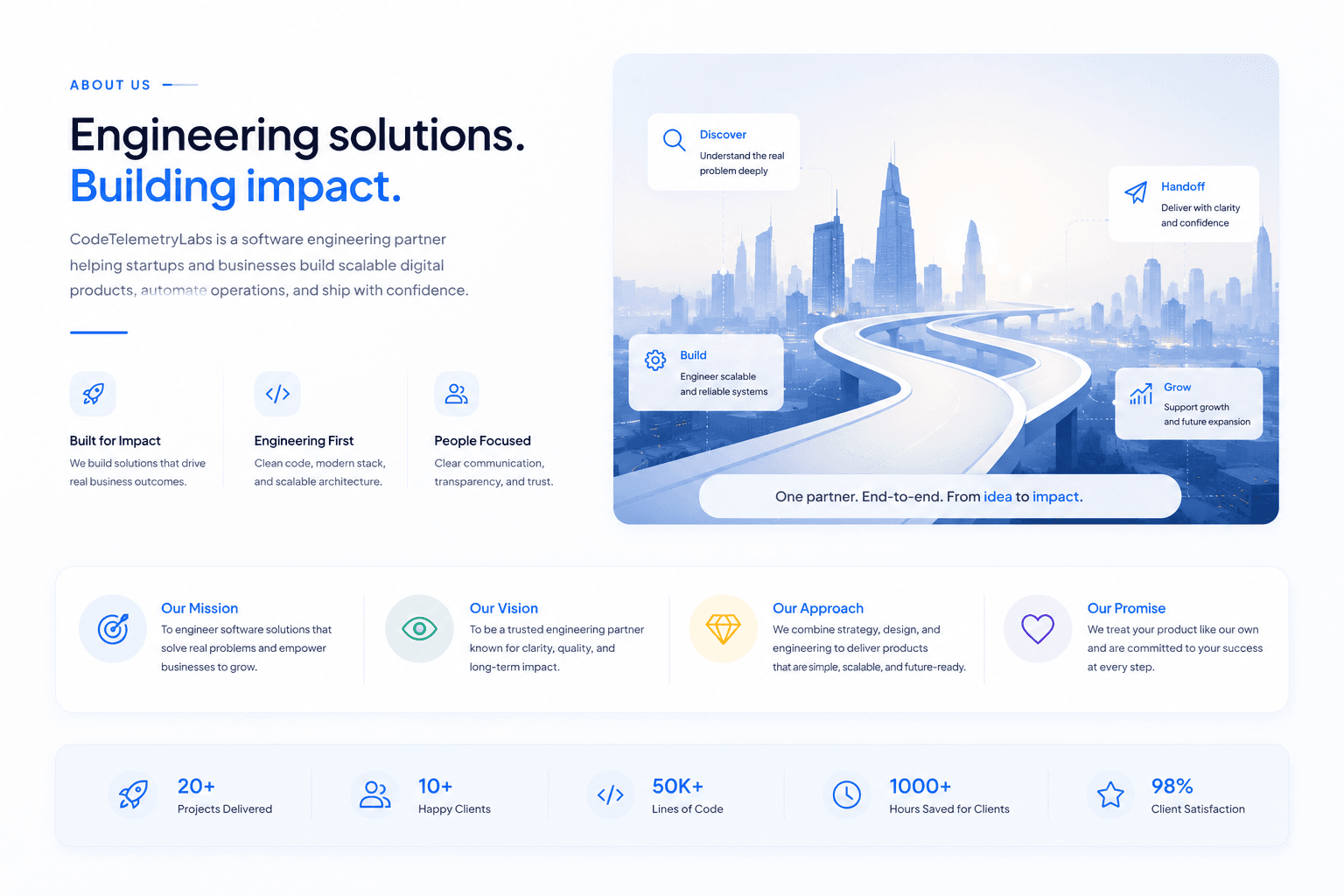
Software fails in the seams: unclear ownership, missing validation, silent jobs, and interfaces that hide state. Our philosophy is to make those seams visible. Discovery produces a decision log. Architecture produces boundaries. Implementation produces vertical slices. Handoff produces runbooks. If a step does not leave an artifact someone else can use, it is incomplete.
We are comfortable saying no to scope that would make the first release dishonest. That is not austerity for its own sake—it is how you learn whether the product works before you decorate it.
Ambiguity is expensive in production. We spend early time on users, constraints, data ownership, and non-goals so implementation time is spent on the workflow that must work.
A feature nobody can pause, audit, or explain is a liability. Logs, roles, and failure paths are part of design—not a polish pass after the demo.
Naming, boundaries, and short decision notes matter more than clever abstractions. The codebase should survive the first staffing change.
We will not invent metrics, logos, or certainty. If a first release cannot include something, it goes on a written non-goals list.
Problem solving
Model choice, framework choice, and vendor choice come after we understand the workflow, data, and review capacity. Layers stay separable so AI features, portals, and integrations can evolve independently.
Weekly working sessions, async updates in a shared channel, and decisions written where the team can find them later. Surprises belong in the product backlog—not in status reporting.
Typed contracts where they prevent drift. Tests on irreversible paths. Accessibility basics on interactive surfaces. Review focused on failure modes, not only style.
We design seams for the next phase—billing, richer admin, extra integrations—without building them prematurely. Debt is named when we accept it.
Because too many deliveries look finished in a slide and fail under operators. The practice exists to ship systems that remain understandable after launch.
After a first release that was honest and operable—portals that need new modules, automation consoles that gain jobs, SaaS foundations that add billing. Continuity comes from trust in the boundary work, not from lock-in.
Can operators run it? Can the next engineer change it safely? Did the release answer the business question you asked? Vanity traffic claims are not on that list.
Read the process, skim a case study, or send a brief. We reply with clarity—not a script.