
Building an MVP sounds simple until you start deciding what actually belongs in it.
A founder has an idea, a list of features, a few competitors to look at, and usually a strong feeling that everything on the list is important.
Then development starts.
A few weeks later, the scope has grown, the budget has increased, and the original goal of getting something in front of users has moved further away.
This is one of the most common problems with MVP development.
The problem usually isn't development itself. It is building too much before learning enough.
A good MVP should help you answer an important business question with the smallest reasonable amount of software.
That doesn't mean building something careless or unfinished. It means being deliberate about what needs to exist in version one and what can wait.
What an MVP is actually supposed to do
MVP stands for Minimum Viable Product.
The important word is not "minimum."
It is viable.
An MVP should contain enough of the product's core experience for real users to interact with it and provide meaningful feedback.
For example, imagine you're building a platform that connects businesses with freelance designers.
You could spend months building:
- Advanced search
- Ratings
- Messaging
- Automated recommendations
- Multiple payment methods
- Mobile applications
- Analytics dashboards
- Referral programs
- Subscription plans
- Complex notification systems
Or you could start by proving one thing:
Can a business successfully find a designer and start a project through the platform?
That question changes the entire scope.
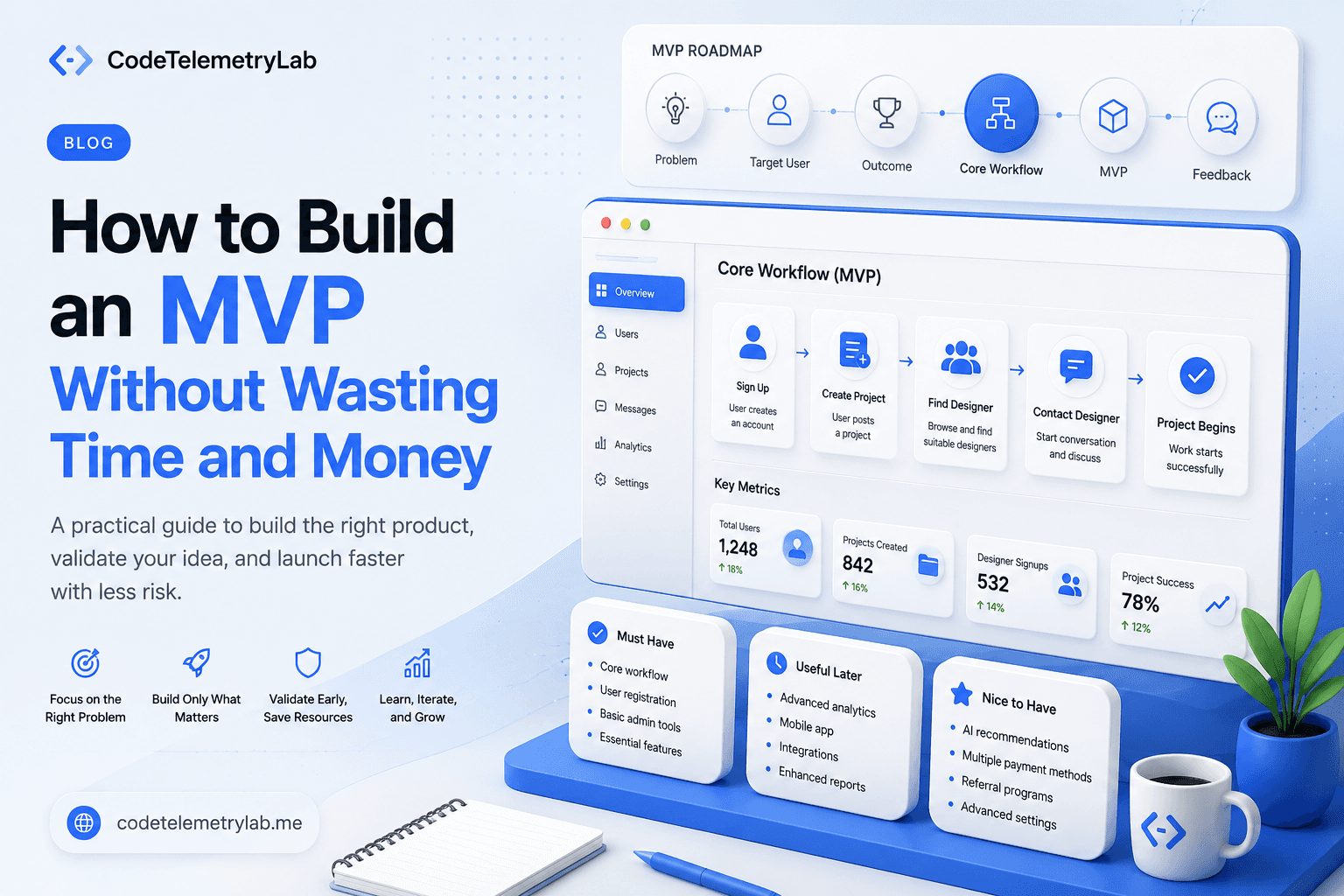
The first version might only need:
Business signs up
        ↓
Creates a project
        ↓
Views suitable designers
        ↓
Contacts a designer
        ↓
Project begins
Everything else can be evaluated after you have evidence that the core workflow works.
Start with the problem, not the feature list
One of the easiest ways to make an MVP expensive is to start development with a long feature list.
A better process starts with the problem.
Ask:
- Who has the problem?
- What are they doing today?
- What makes the current process difficult?
- What outcome are they trying to achieve?
- What is the most important action your product needs to enable?
Then define the smallest workflow that delivers that outcome.
A useful progression is:
Problem
   ↓
Target user
   ↓
Desired outcome
   ↓
Core workflow
   ↓
Required features
   ↓
Technical architecture
   ↓
MVP
   ↓
Real user feedback
Technology comes later.
This prevents you from choosing a complicated architecture for a product whose requirements are still unclear.
Decide what the MVP needs to prove
Every MVP should have something it is trying to validate.
That might be:
- Will users pay for this?
- Will businesses use this workflow?
- Can we reduce a manual process?
- Will customers return to the product?
- Can the product replace an existing process?
- Does this solution solve the problem better than the current alternative?
Suppose you're building an AI support product.
You don't necessarily need to prove that you can build a sophisticated autonomous AI system.
Your first question might simply be:
Can the system resolve a meaningful percentage of common support requests without requiring an employee to handle every conversation?
That could lead to a much smaller MVP.
Customer question
       ↓
AI understands request
       ↓
Searches approved knowledge
       ↓
Generates response
       ↓
Human reviews when necessary
Once you know that workflow works, you can decide whether additional capabilities are worth building.
Not every feature belongs in version one
A useful way to prioritize features is to divide them into three groups.
Must have
The product cannot deliver its core value without them.
Useful later
They improve the experience but aren't necessary to validate the idea.
Nice to have
They may be valuable eventually but don't help answer the first important business question.
For example:
| Feature | MVP? | Reason |
|---|---|---|
| User registration | Usually | Required to access the product |
| Core workflow | Yes | This is what you're validating |
| Basic admin tools | Usually | Needed to operate the product |
| Payment processing | Depends | Required if payment is part of validation |
| Advanced analytics | Usually no | Can come after initial usage |
| Mobile application | Usually no | Validate the core product first |
| Multiple integrations | Usually no | Add based on real demand |
| AI recommendations | Depends | Include only if central to the value |
| Complex reporting | Usually no | Often unnecessary initially |
There isn't a universal MVP feature list.
The right features depend on what you're trying to learn.
An MVP doesn't always mean a full SaaS application
Another common misconception is that an MVP has to be a complete software product with every system automated.
It doesn't.
Depending on the idea, you could start with several different approaches.
Prototype MVP
Useful when the biggest uncertainty is the user experience.
You may need to test:
- Navigation
- Product concept
- Core screens
- User flow
Concierge MVP
The customer sees a product-like experience while some work is performed manually behind the scenes.
This can be useful when you want to validate demand before investing in complex automation.
Internal MVP
Instead of selling the product immediately, build a small internal system to test the workflow with your own team or a controlled group of users.
SaaS MVP
A real web application that users can access and use independently.
AI MVP
A product where AI is part of the core experience, such as:
- Document processing
- AI assistants
- Intelligent search
- Content analysis
- Workflow decisions
- Customer support
The right approach depends on what needs to be validated.
Don't choose technology because it is popular
There is no single "best" technology stack for every MVP.
A typical product might use:
- Next.js or React for the frontend
- Python or Node.js for backend services
- PostgreSQL for structured data
- APIs for external integrations
- Cloud infrastructure for deployment
But the stack should follow the product requirements.
For example, if your MVP requires complex data processing, Python may make sense.
If the product is heavily centered around a modern web interface, React or Next.js may be appropriate.
If your product needs relational data and transactions, PostgreSQL can be a strong choice.
The important question isn't:
"What is the most modern stack?"
It is:
"What technology lets us build and operate this product reliably without adding unnecessary complexity?"
An MVP is not the time to collect technologies.
It's the time to solve the problem.
Keep the architecture simple, but don't make it disposable
There is a misconception that MVP development means writing code that will immediately be thrown away.
That's not always necessary.
You don't need to build a massive enterprise architecture on day one.
But you also shouldn't create a codebase that becomes impossible to maintain after the first release.
A reasonable MVP should still have:
- Clear application structure
- Sensible database design
- Basic authentication and authorization
- Error handling
- Logging
- Version control
- Testing around important functionality
- Secure handling of credentials
- A deployment process
The goal is a foundation that can evolve.
You want to avoid both extremes:
Over-engineering
        ↓
Too much time + cost
and:
Throwaway engineering
        ↓
Fast launch + expensive rebuild
The useful middle ground is focused engineering.
What usually makes an MVP expensive?
The number of features matters, but it isn't the only factor.
Development effort can increase significantly because of:
Integrations
Every external system introduces another dependency.
Examples include:
- Payment providers
- CRMs
- Email services
- Accounting systems
- External APIs
- Identity providers
User roles
A product with one user type is usually simpler than one with:
- Customers
- Administrators
- Managers
- Vendors
- Operators
Each role can introduce different permissions and workflows.
Complex business logic
A simple CRUD application is very different from a system with complicated pricing, approvals, matching, scheduling or financial calculations.
AI requirements
AI can add additional work around:
- Model integration
- Prompt design
- Retrieval
- Tool calling
- Evaluation
- Cost management
- Guardrails
- Monitoring
Security requirements
Products handling sensitive information require more careful architecture, access controls and testing.
The important point is that MVP cost is driven by scope and complexity, not simply by the number of screens.
Don't build every integration on day one
Integrations are particularly tempting.
A founder might say:
"We need Salesforce, HubSpot, Slack, Google Workspace, Stripe, Xero and six other systems."
Maybe eventually.
But ask whether each integration is necessary for the first product validation.
If the core workflow can be tested with one integration and some manual operations, start there.
Once customers consistently request another integration, you have evidence that it deserves development time.
This is much safer than building ten integrations based on assumptions.
Mobile app or web application?
For many early-stage products, a web application is a sensible starting point.
That's not because mobile applications are bad.
It's because building and maintaining separate iOS and Android applications adds another layer of development and testing.
If the core product can be validated through the web, you may be able to learn faster before investing in native applications.
But there are exceptions.
If the product depends on:
- Camera access
- GPS
- Push notifications
- Offline functionality
- Device hardware
then a mobile application may be justified from the beginning.
Again, the product requirement should determine the architecture.
AI should also earn its place in an MVP
Adding AI because it is currently popular is not a good reason to put it into your product.
Ask what the AI is actually doing.
For example:
Weak reason:
"We want an AI chatbot because every SaaS product has one."
Stronger reason:
"Users currently spend ten minutes searching through documents to find information, and an AI-powered search experience could reduce that effort."
The second statement gives you something measurable.
AI can be valuable when it helps with:
- Unstructured information
- Natural-language interaction
- Classification
- Extraction
- Summarization
- Recommendations
- Complex search
- Context-dependent decisions
But if a simple rule solves the problem, use the rule.
Build around one core workflow
A useful MVP often has one workflow that matters more than everything else.
For example:
User
  ↓
Creates request
  ↓
System processes request
  ↓
User receives result
  ↓
User takes next action
If that workflow creates real value, you have something to build on.
If the workflow doesn't work, adding dashboards, notifications and extra settings won't fix it.
This is why the core workflow should be defined before the feature list.
Launch early, but don't confuse small with unfinished
An MVP can be small and still be professional.
There is a difference between:
Limited scope
and
Poor quality.
A first release may have only five important features while still being:
- Stable
- Usable
- Secure enough for its intended environment
- Monitored
- Maintainable
Users don't need every feature.
They do need the features you give them to work.
What happens after the MVP?
The MVP isn't the end of development.
It is the beginning of learning.
A useful product cycle looks like:
MVP
 ↓
Real users
 ↓
Usage data
 ↓
Feedback
 ↓
Identify problems
 ↓
Prioritize changes
 ↓
Build next version
 ↓
Measure again
Now you have information that wasn't available when the product was only an idea.
You can see:
- Which features people actually use
- Where users stop
- What customers request
- What causes support issues
- Which workflows need improvement
- What users are willing to pay for
That information should determine the next development cycle.
How CodeTelemetryLab approaches MVP development
At CodeTelemetryLab, we don't start an MVP project by assuming that every idea needs a large application.
We start by understanding the product and the business problem.
That means looking at:
- The target users
- The core problem
- The primary workflow
- Required features
- Technical constraints
- Integrations
- AI requirements, if any
- Security considerations
- Expected users
- Future requirements
- Budget and timeline
From there, the goal is to define a practical first version.
Sometimes that means building a SaaS application.
Sometimes it means an internal tool.
Sometimes it means an AI-powered workflow.
And sometimes the best recommendation is to reduce the scope before development begins.
That's an important part of engineering work.
The objective isn't to build the most software possible.
It's to build enough software to create value and learn what should happen next.
A practical MVP checklist
Before starting development, you should be able to answer:
- Who is the first user?
- What problem are they experiencing?
- What outcome are they trying to achieve?
- What is the core workflow?
- What does the MVP need to prove?
- Which features are absolutely necessary?
- Which features can wait?
- Does the product actually need AI?
- Which integrations are required?
- What level of security is necessary?
- How will success be measured?
- What happens after launch?
If several of these questions don't have clear answers, more planning may be useful before development begins.
Final takeaway
A good MVP isn't simply the smallest product you can build.
It is the smallest useful product that can answer an important question.
Start with the problem.
Understand the user.
Define the core workflow.
Remove features that don't help validate the idea.
Choose technology based on the actual requirements.
Build enough quality into the foundation that the product can evolve.
Then get it in front of real users and learn from what happens.
The goal of an MVP isn't to predict the entire future of the product.
It's to reduce uncertainty before you spend more time and money building it.
Have an MVP idea but aren't sure what to build first?
CodeTelemetryLab can help you break down the idea, identify the core workflow, decide what belongs in the first version, and choose a practical technical approach.
If you have an MVP idea, tell us what you're trying to build and what problem it is meant to solve.
We'll start with the problem, not the feature list.